Posts

Singapore Healthcare Services

Image
Primary Healthcare Services Primary care is the foundation of our healthcare system. As the first line of care in the community, our primary care professionals are often the first point of contact with patients. They provide holistic and personalised care for patients of different age groups. They treat acute conditions such as upper respiratory tract infections, manage chronic illnesses such as diabetes, and keep the population healthy through preventive measures such as targeted health screening. They also help to coordinate patients' care with other providers and help patients who require more specialised medical attention to navigate the healthcare system. In Singapore, primary care is provided through an island-wide network of outpatient polyclinics and clinics run by private general practitioners (GPs). There are currently 23 polyclinics and about 1,800 GP clinics. GP Clinics: There are about 1,800 GP clinics, which meet about 80% of the total primary care demand. These range...

LPA: Lasting Power of Attorney

Image
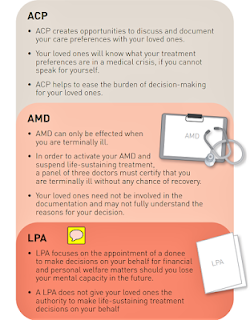
Healthcare in Singapore THE LASTING POWER OF ATTORNEY (LPA)​allows you to legally appoint one or individuals to make decisions on your behalf if you are mentally incapacitated A lasting power of attorney (LPA) is a type of advance directive that allows you to legally appoint one or more individuals to make decisions and act on your behalf if you are mentally incapacitated. This legal document is made under the Mental Capacity Act in Singapore. Anyone who is 21 years old and above, and has the mental capacity to make an LPA, is eligible to make one. The legal term for the person who makes the LPA is a donor and the person who is appointed is known as the donee. A donor can appoint one or more donees to act in one or both of the following areas: Personal welfare and healthcare Property and affairs Your donee should be at least 21 years old and someone who you believe is trustworthy, reliable and competent to make decisions for you. “The LPA only kicks in when the donor loses capacity to ...

​​ AMD: Advance Medical Directive

Image
Advance Care Planning for Future Health Crises Advance Care Planning (ACP) and Advance Medical Directive (AMD) are two tools that you can use to indicate your preferences for medical care for future contingencies, when you are not able to make decisions for yourself. These directives guide healthcare professionals and your loved ones when making decisions on your behalf, and more importantly, it relieves loved ones of the burden of not knowing what you would have wanted. “By indicating your preferences in advance, you can ensure that you will get the medical care you desire during a future medical crisis,” says Ms Sumytra Menon, Senior Assistant Director, Centre for Biomedical Ethics (CBmE), Yong Loo Lin School of Medicine, National University of Singapore (NUS). The ACP process consists of a series of wide-ranging discussions with loved ones you have selected and doctors and facilitated by a trained ACP facilitator on your future health and personal care preferences. At the end of the...

Making Best Choices for Your End-of-Life Care

Image
ACP, AMD & LPA His hospital bill: $1.2 million This is not what someone paid for a home. Rather it is the medical bill businessman Danny Foo accumulated for the 14 months he was in a vegetative state. The 48-year-old partner of Quayside Group died last Tuesday. He had collapsed and fallen into a coma in July last year, two weeks after he first sought treatment for an infected leg at a private hospital. "Fortunately, Danny had the foresight to buy insurance early. We have only to pay 10 per cent of the bill, but $120,000 is still a pretty huge amount for the family to pay," Mr Foo's elder brother Steven, 49, told The New Paper. source

Great Money Habits for Your Children

Image
A supermarket cashier overpays a shopper mom $10 in change. On realising it, the mother promptly returns the excess, knowing the cashier would have to pay for her shortfall from her own purse. Her 7-year-old observes the casual exchange and learns — not just about the virtues of honesty but also that people are worth more than money. Family money values are not printed on a prominently hung poster at home. Instead, they are imprinted in the minds and hearts of our children in a way that can shape their financial and life decisions well into their adulthood. Are experiences more important than things? Is quantity prized over quality? Is it okay not to return money borrowed because it’s just a small sum? What are your family’s money values? While every child will grow up to have their own money values, much of their financial management prowess in the future will be shaped by lessons learned, intentionally or otherwise, in their formative years. source